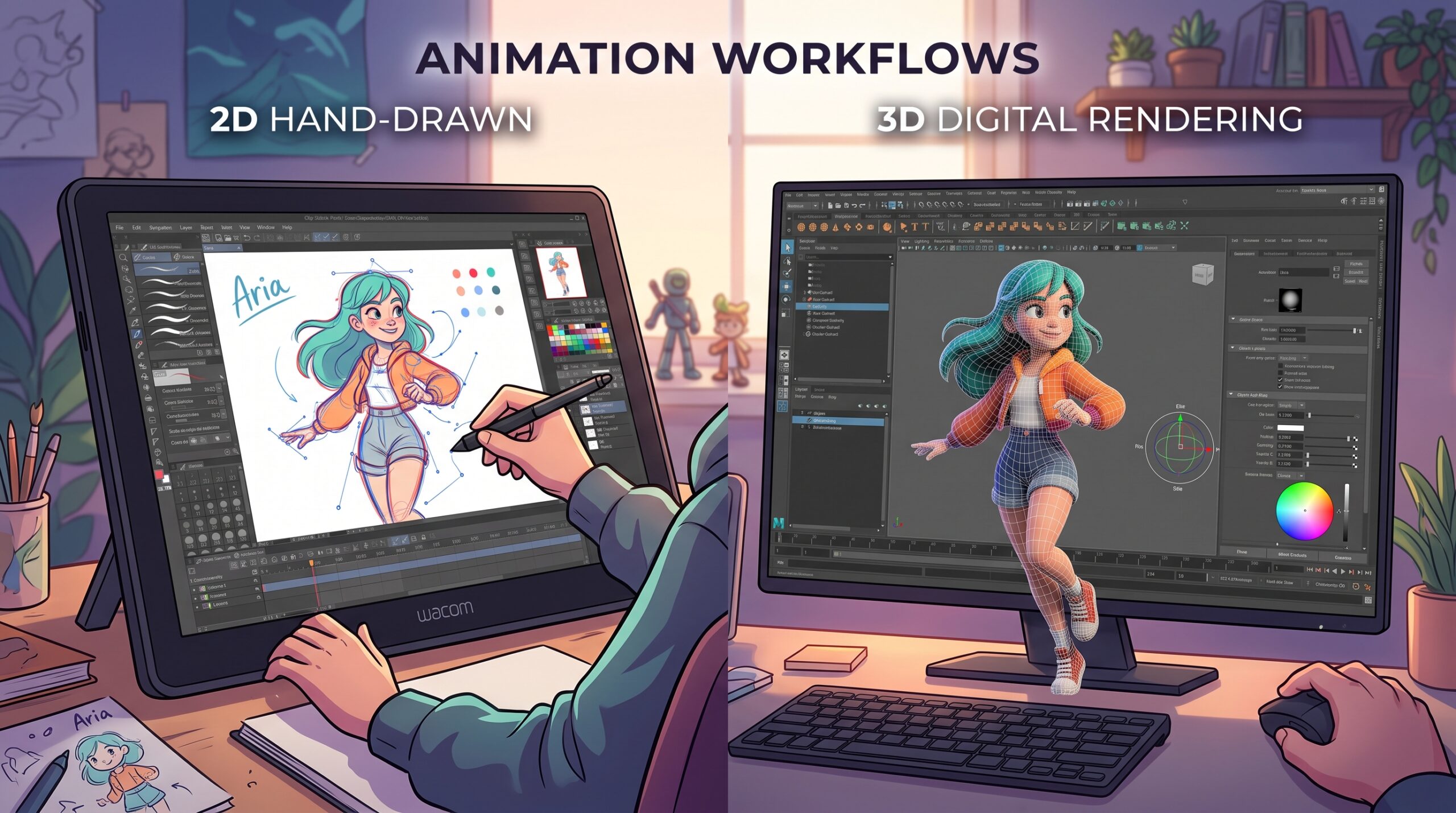
When you decide to dive into animation, one of the first crossroads you encounter is choosing between 2D and 3D animation. Both mediums allow you to bring characters and environments to life, but the daily workflow, required toolsets, and ultimate output look very different.
Understanding how these two styles function will help you decide where to focus your time when starting out.
The Fundamental Difference
The core distinction comes down to how you create motion on screen.
In 2D animation, you operate strictly in a two-dimensional space focused on height and width. You either draw frame by frame or manipulate flat vector graphics on a screen.
In 3D animation, you work inside a virtual three-dimensional space that includes depth. Instead of drawing every single frame, you manipulate digital models built around virtual skeletons. You act more like a digital puppeteer, posing the character at key points while the software handles the smooth transition between those poses.
What Working in 2D Animation Looks Like
2D animation relies heavily on traditional visual art principles. If you enjoy sketching, character illustration, and expressive movement, this workflow often feels natural.
- Key Focus: Drawing fundamentals, line quality, character posing, and frame timing.
- Common Software: Adobe Animate, Toon Boom Harmony, TVPaint.
- Popular Applications: Television shows, web series, animated ads, and mobile games.
What Working in 3D Animation Looks Like
3D animation leans further into spatial mechanics, virtual physics, and asset creation. You do not need to be a master illustrator to excel here, but you do need an eye for weight, perspective, and digital lighting.
- Key Focus: Spatial awareness, rigging mechanics, camera placement, and digital sculpting.
- Common Software: Blender, Autodesk Maya, Cinema 4D.
- Popular Applications: Visual effects, feature films, modern console video games, and product visualizations.
Which Path Is Right for You?
Neither medium is inherently superior to the other, and both rely on the exact same core principles of timing, weight, and anticipation.
If you love illustration, flat graphics, and traditional art, start with 2D. If you enjoy working with digital cameras, building models, or exploring virtual environments, start with 3D.
Whichever path you select, the foundational skills you learn will transfer directly if you ever decide to explore both. Choose the workflow that excites you most right now, and begin experimenting with basic movements.