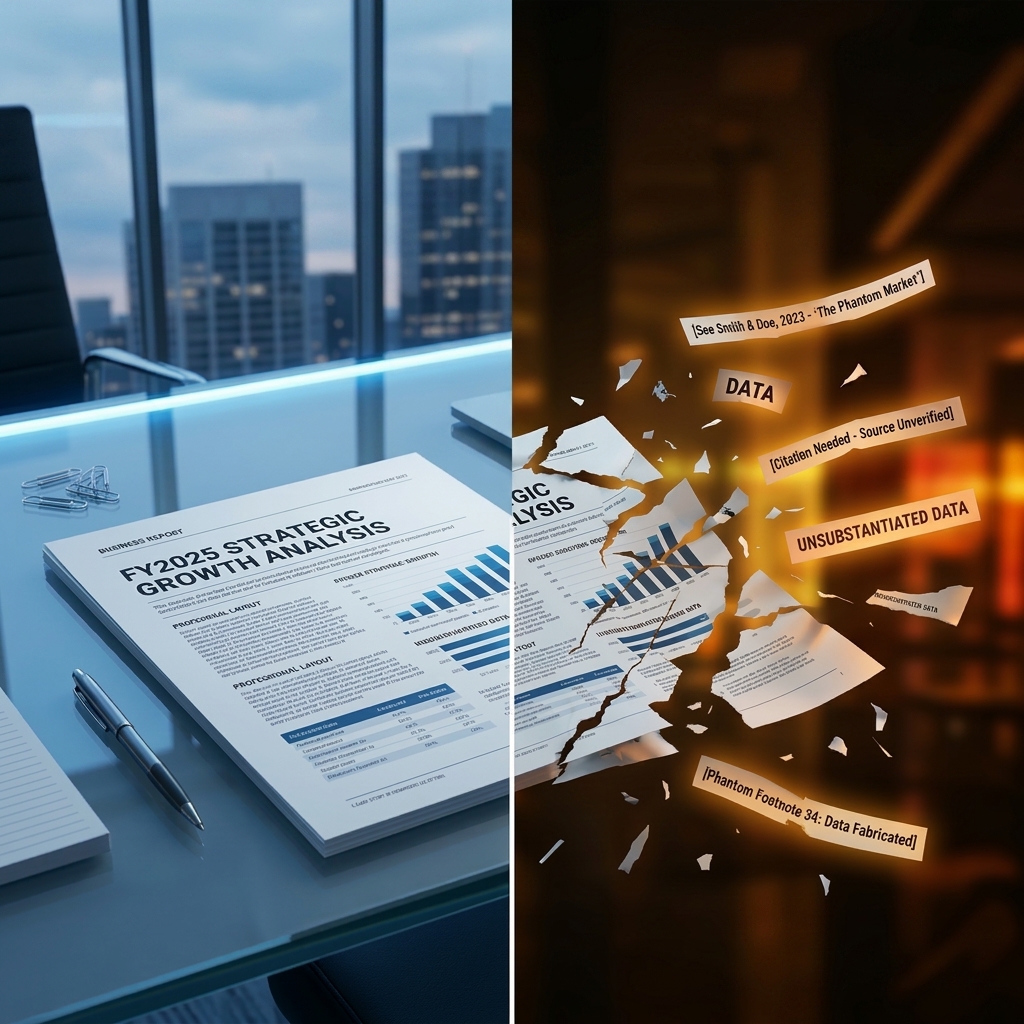
You have probably seen an AI tool produce a perfect paragraph, a detailed analysis, or a polished citation and thought, “That looks right.” The grammar is clean. The structure is professional. The tone is authoritative. The problem is that none of those qualities guarantee accuracy.
AI does not know what is true. It predicts what words should come next. When it generates a citation, a statistic, or a legal reference, it is not retrieving a fact from a database. It is constructing something that looks like a fact. The result is often indistinguishable from real research, which makes it more dangerous than an obvious error.
This is not a theoretical risk. Some of the largest professional services firms in the world have already published AI-generated errors in high-stakes government and client reports. Here is what happened, what it cost them, and what it means for your business.
The Deloitte Australia Report
In 2025, Deloitte Australia delivered a 237-page report to the Australian government’s Department of Employment and Workplace Relations. The report reviewed the IT system used to automate penalties in the country’s welfare system. The contract was worth approximately $290,000.
A researcher at Sydney University, Chris Rudge, discovered that the report contained fabricated references, including a fake quote attributed to a federal court judge and citations to academic research papers that did not exist.
One citation incorrectly stated that a Sydney University professor had authored a non-existent book with a title outside her field of expertise. Rudge noted that he “instantaneously knew it was either hallucinated by AI or the world’s best kept secret.”
Deloitte confirmed that some footnotes and references were incorrect. A revised version disclosed that Azure OpenAI had been used in the report’s creation. The firm agreed to partially refund the government. Australian Senator Barbara Pocock stated that Deloitte “misused AI and used it very inappropriately: misquoted a judge, used references that are non-existent.”
The Deloitte Canada Report
Months later, a second Deloitte report came under scrutiny. This time it was a 526-page health care report for the Canadian province of Newfoundland and Labrador, a project that cost nearly $1.6 million.
The report contained at least four citations to research papers that do not exist. These false citations were used to support claims about recruitment strategies, monetary incentives, virtual care, and the impacts of the COVID-19 pandemic on health care workers.
One citation attributed a cost-effectiveness analysis of rural nursing retention to professor Martha MacLeod. She told reporters the citation was “false” and “potentially AI-generated,” noting that her team had never conducted such an analysis and never had the financial data to do it.
Another supposed paper was cited to support a claim about local recruitment being the most cost-effective strategy. One of the authors named told The Independent that while she had worked on the topic, “the paper itself does not exist.”
Deloitte Canada stated it stands behind the report’s recommendations and said AI was not used to write the report, only to support a small number of research citations. The firm committed to reviewing all citations and reporting back to the government.
The PwC Middle East Reports
PwC faced similar scrutiny in 2026 when researchers at GPTZero investigated four “thought leadership” reports published by PwC Middle East between 2024 and 2026. The reports covered topics including corporate strategy for autonomous AI bots, government public service guides, and regional forecasts for electric and autonomous vehicles.
The investigation found a pattern of fabricated claims and hallucinated citations. One report cited an academic paper on air quality in Riyadh that appeared to be completely invented, with no record of the study in the cited journal or under the listed authors.
Multiple footnotes linked to broken web pages or articles that did not mention the claims they were supposed to support.
In one report titled “Transforming Governance,” PwC claimed that a framework called “Citizen Pulse” was transforming governance structures across the region and that governments in Denmark, Saudi Arabia, the United States, and Australia were already using it. The cited government portal pages contained no mention of Citizen Pulse. Researchers concluded that the claim was almost certainly fake.
PwC Middle East told the Financial Times that it takes the accuracy of its published research seriously and is updating a limited number of supporting citations.
Why This Matters for Your Business
These were not amateur mistakes. They were produced by global firms with massive budgets, dedicated research teams, and every incentive to get it right. If Deloitte and PwC can publish fabricated court quotes, fake academic papers, and imaginary government programs, the risk for a smaller business is not smaller. It is larger, because you have fewer layers of review and less reputational cushion to absorb the damage.
The specific danger is not that AI makes mistakes. The danger is that it makes mistakes with complete confidence. A wrong number in a spreadsheet looks wrong. A fabricated citation in a polished report looks like due diligence.
What to Do Instead
You do not need to stop using AI. You need to change how you verify it.
First, separate generation from verification. The person who uses AI to draft a document should not be the only person who checks it. A second pair of eyes, preferably someone with subject matter expertise, should review any claim, number, or citation before it goes to a client, a regulator, or the public.
Second, verify citations independently. Do not click the link AI provides and assume the source supports the claim. Open the source yourself. Read the relevant section. Confirm the page number, the quote, and the conclusion. If you cannot find the source, delete the citation.
Third, never use AI output as a final version for anything with financial, legal, or client-facing stakes without full human review. AI is useful for outlines, first drafts, and brainstorming. It is not a substitute for professional judgment on deliverables that affect contracts, compliance, or revenue.
Fourth, document your process. If you use AI in a report, note where and how. This is not about transparency for its own sake. It is about accountability. When a client or regulator asks how you reached a conclusion, you need to show your work, not just your output.
The Bottom Line
AI is a tool that predicts language, not truth. The Deloitte and PwC cases show what happens when businesses forget that distinction. The firms did not fail because they used AI. They failed because they treated AI output as finished work.
Your competitive advantage is not using AI faster than your competitors. It is using it more carefully. The business that verifies its work will outlast the business that publishes it first.
If you want to learn how to build verification, workflow design, and risk management into your AI use, our AI for Business program at the Media Arts Center in Charlotte covers exactly that. Four courses, twelve labs, and a certificate of completion.
Learn more here: https://mediaartsonsite.com/ai-for-business-school