Replace Scrolling with Drawing: Four Micro Exercises for Aspiring Animators
The average person spends over two hours daily on social media, often in short sessions of ten to fifteen minutes. These small blocks of time are usually treated as mental breaks, but they can also function as low pressure practice sessions for animation fundamentals.
Animation does not require hours of uninterrupted studio time to improve. Short, consistent practice builds observation skills and muscle memory more effectively than occasional long sessions. Below are four exercises, each designed to fit within a standard scrolling break.
Exercise 1: The Three Pose Study (3 minutes)
Choose any moving object or person in your immediate environment. A pet walking across the room. A tree branch swaying. A person reaching for a coffee cup.
Observe the action and identify three key moments: the start, the middle, and the end. Sketch each pose as a simple stick figure or basic shape. Do not worry about detail. The goal is to train your eye to see motion as a sequence of poses rather than a blur.
This is the foundation of keyframe animation. Professionals use this same method when planning complex scenes.
Exercise 2: The Shape Morph (5 minutes)
On any blank surface, draw a simple geometric shape: a circle, square, or triangle. In the next frame, redraw it with one small change. Continue for five to eight frames until the shape has transformed into something new.
This teaches inbetweening, the process of creating transitional frames between two poses. It also builds patience for repetitive drawing, which is essential for traditional and digital animation alike.
A phone notes app, a sticky note, or a small pocket notebook works well for this.
Exercise 3: The Bouncing Ball Timer (2 minutes)
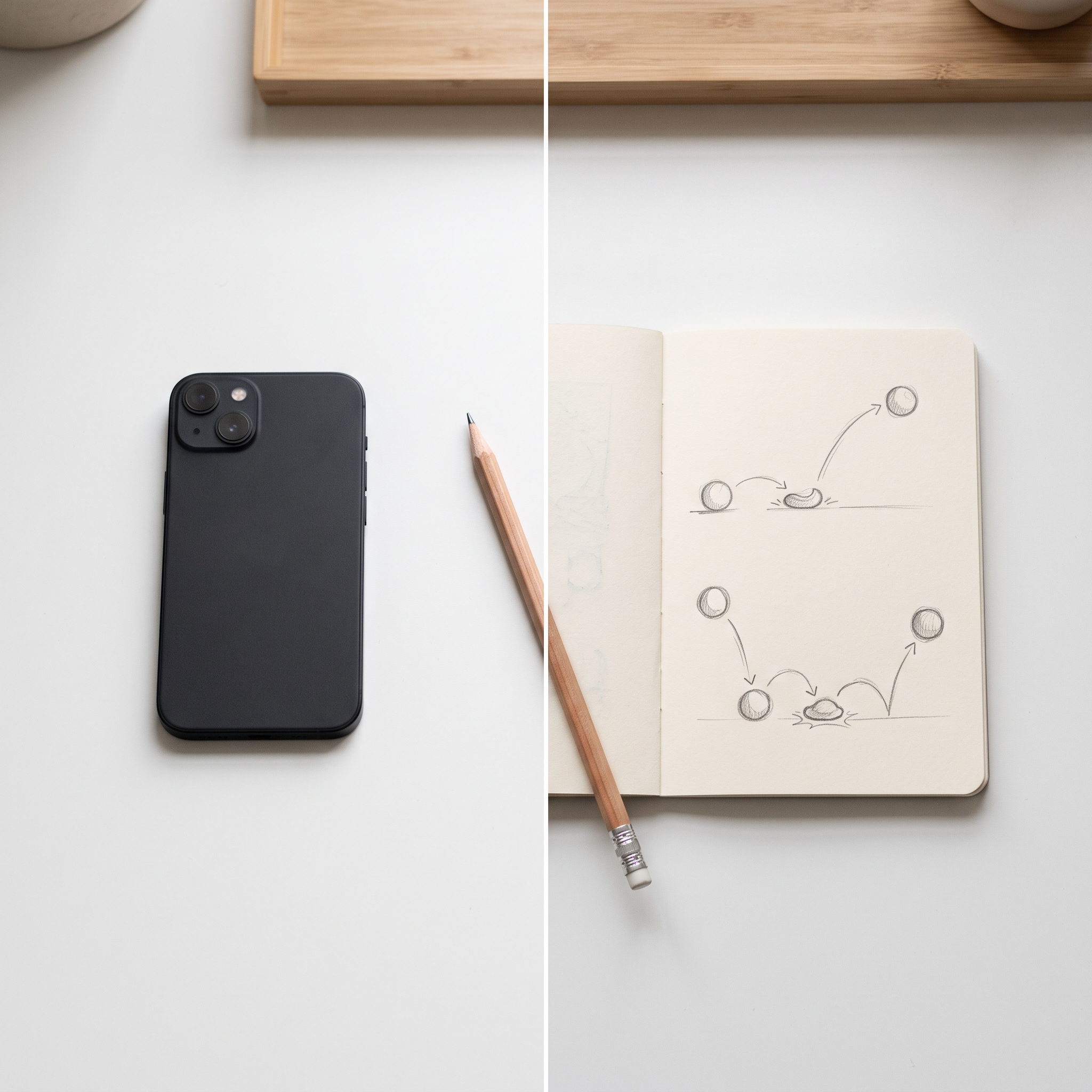
Set a timer for two minutes. Draw a ball bouncing from left to right across a page. Use no more than six drawings. When the timer ends, stop.
This creates a time pressure that mirrors real production deadlines. It also forces decisions about spacing. If the ball looks too fast or too slow, that is useful information. Adjust the spacing in the next attempt.
Repeat this exercise daily for one week. The improvement in timing judgment will be noticeable.
Exercise 4: The Scroll Replacement Loop (10 minutes)
Instead of opening a social media app, open a blank drawing app or grab paper. Draw a simple character or object performing a looped action: a waving hand, a blinking eye, a spinning wheel.
Create four to six frames. Photograph them and scroll through them on your phone. Save the sequence and return to it the next day to add one additional frame or refine a pose.
Over one month, this produces a small library of motion studies. More importantly, it establishes a habit of creating rather than consuming during idle moments.
Learn By Doing
Social media scrolling provides novelty but rarely builds skill. Animation exercises provide the same mental break while creating cumulative improvement. Ten minutes of drawing teaches more about movement than ten minutes of watching movement.
The exercises above require no special software, no formal training, and no finished artwork. They require only the decision to use existing downtime differently. Ready to learn?